Balatro
- 4.7
- Rating
- 1.00M
- Installs
- $9.99
- Price

 Analysis by App-foxy
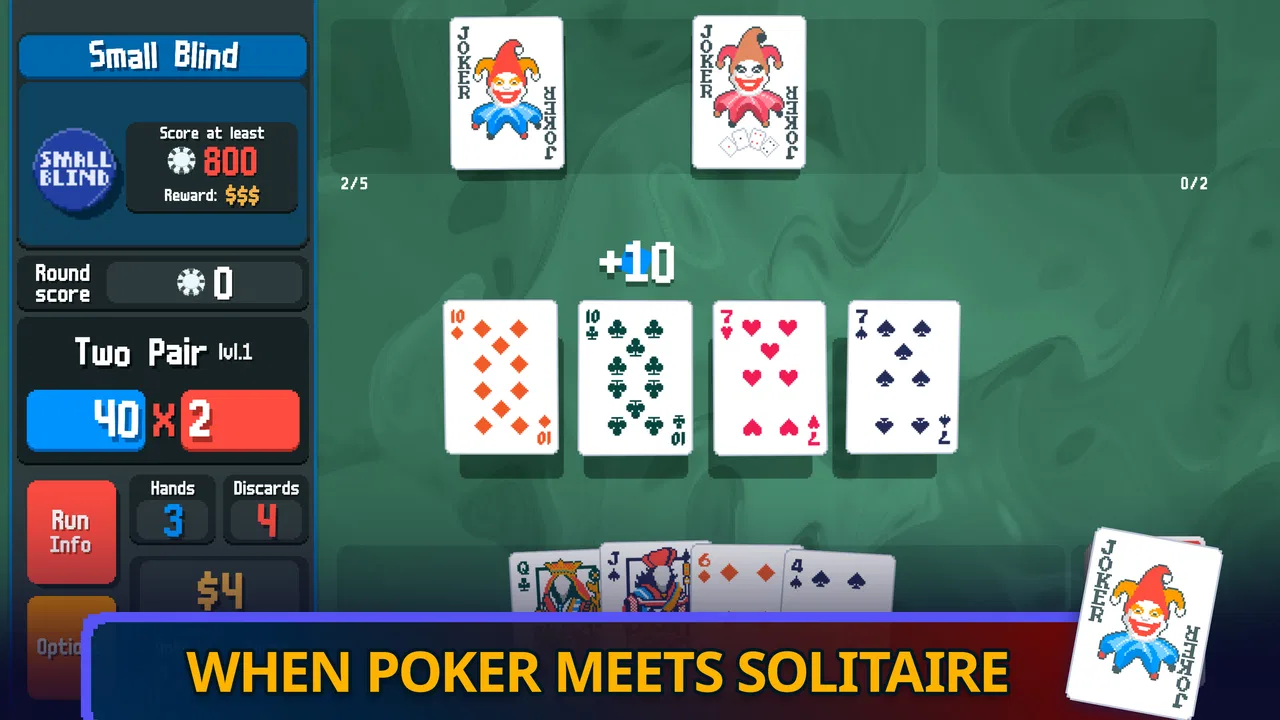
I went into Balatro expecting a clever card game and found something much more absorbing: a game that turns familiar poker hands into a flexible, score-chasing puzzle. Developed by Playstack, this paid card game is built around the idea of combining poker patterns with solitaire-style planning, but that description only hints at why it works. The real appeal is deciding which cards, bonuses, and risks are worth carrying forward when a promising run can change direction in a single round.
It is available for Android and iOS, costs $9.99, and carries an Everyone 10+ rating. The mobile release arrived on September 24, 2024, and the current version is 0.7. That makes the game easy to place: it is not a free time-killer designed around constant interruptions, but a premium experience for people who want a focused game they can return to repeatedly.
My overall impression is very positive, although I would not recommend it blindly. Balatro rewards patience, experimentation, and comfort with losing a run after making several decisions that seemed sensible. If you want a calm solitaire session with predictable progress, or a traditional poker game with realistic opponents, this is a very different proposition. If you enjoy building combinations and testing how far a strategy can stretch, it is one of the most distinctive card games I have played on a phone.
You May Also Like

 Blood Strike: 2.5 Anniversary
Blood Strike’s Loadouts Turn Every Drop Into a Tactical Gamble
A close look at Blood Strike’s custom loadouts: how fast access to signature weapons reshapes its battle royale rhythm, rewards preparation, and narrows the gap between fights.

 Pandora - Music & Podcasts
Pandora’s Music Is Easy to Start, but Harder to Recover
Pandora’s strength is its low-effort path from a seed to a station. Its weak spot is how much confidence it asks you to place in connection, setup, and quiet recovery.

 8 Ball Pool
 Is Built on Rivalries, Rematches, and Routine
A close look at the rivalries, rematches, shared routines, and unanswered safety questions that turn a quick pool match into a persistent mobile community.

 Samsung Music
’s Quiet Strength Is Playing What You Already Own
Its reach comes less from spectacle than from dependable access to a personal library. That simplicity is both the app’s strongest retention engine and its ceiling.

 AccuWeather: Weather Radar
AccuWeather Review: A Quick, Clear Forecast for Everyday Decisions
For everyday plans, the best forecast is the one you can understand quickly. AccuWeather makes rain timing, radar, and local conditions easy to act on, with a few trade-offs.

 Hill Climb Racing
Why Hill Climb Racing Still Turns Crashes Into One More Run
A tiny car, a bumpy hill and one more upgrade: Hill Climb Racing keeps resurfacing because its simple chaos makes every near-miss feel personal.
More From Our News Desk



How the game feels in everyday play
I find the everyday appeal of Balatro less in squeezing a whole run into every spare minute and more in how each hand gives me a clear point to pause and reassess. That makes it easier to fit around an unpredictable day, while still rewarding me for remembering what my current strategy needs. The next section looks at how that decision-making rhythm feels once the initial novelty wears off.
Quick turns, but not a mindless pace
The basic interaction feels responsive because each decision is compact. You inspect your hand, choose a possible poker combination, play it, and then decide how to manage the rewards that follow. The game does not need long action sequences to create tension. The pressure comes from knowing that a hand which looks strong now may be less useful than a weaker-looking choice that supports your wider build.
That makes it well suited to short sessions. I can imagine playing during a commute, while waiting for an appointment, or at the end of the evening without needing to reserve a large block of time. The important distinction is that a short session can still feel meaningful. Even when a run ends quickly, I usually leave with a better idea of which choices were too greedy or which combinations deserve another attempt.
The pace also depends on how much time I spend thinking. Experienced players may move through ordinary hands quickly, while a new player can pause over every possibility. That is not a flaw, but it means the game feels faster as its rules become familiar. The opening hours are less about reflexes and more about learning how the scoring logic fits together.
The useful speed advantage is decision density, not instant action. Balatro gives me several meaningful choices in a small amount of screen time. That is why it feels more substantial than a typical quick card game, even when a single hand takes only a moment to resolve.
Why poker knowledge helps, but does not decide everything
Knowing the usual poker hands gives a new player a helpful starting point, but it is not enough to master the game. A pair, straight, flush, or other familiar hand is only the visible foundation. The more important question is whether that hand fits the bonuses and long-term direction of the current run.
This creates an interesting trade-off for people who already know poker. Familiarity helps with recognizing possible hands, yet it can also encourage rigid thinking. In ordinary poker, the value of a hand is tied to opponents and probabilities. Here, the value changes according to the tools and scoring opportunities available during the run. I had to stop asking, “What is the strongest hand?” and start asking, “What is the strongest hand for this build right now?”
For someone who has never played poker, the learning curve is still manageable because the game teaches through repetition. The challenge is not memorizing a complicated rulebook. It is understanding why a modest hand can sometimes be more practical than a spectacular one, especially when the available resources and future targets do not support the obvious choice.
The first important habit: protect the run before chasing a perfect score
One of the less obvious lessons is that a run often fails because I keep optimizing for a bigger number after I already have a safe route forward. It is tempting to use every available opportunity to increase a hand’s value, but that can leave the next round poorly prepared. A smaller, reliable gain may preserve flexibility, while a flashy play can consume the tools needed later.
I now treat each round as both a scoring problem and a preparation problem. Before committing to a hand, I consider what the next few decisions might require. That does not guarantee success, but it reduces the feeling that losses are random. When a run collapses, I can usually identify whether I overvalued immediate points, ignored the shape of my deck, or kept a strategy alive after it had stopped producing useful results.
Build choices create the real depth
The game becomes much more interesting once I stop treating each hand as an isolated event. The choices between rounds shape the next stage of the run, and the best decision is not always the most powerful-looking item or bonus. Sometimes the right move is the one that supports consistency. Sometimes it is worth accepting a narrower plan because the potential payoff is much higher.
This is where Balatro feels closer to a roguelike strategy game than to ordinary solitaire. A run has a direction, and that direction can be strengthened, adjusted, or abandoned. I enjoy that sense of construction because it gives every session its own personality. Two runs can begin with similar cards and still develop into very different puzzles.
A practical tip is to decide what your current build is trying to do before spending resources on attractive extras. If the plan depends on repeating a particular type of hand, a bonus that improves unrelated hands may be less useful than it first appears. Conversely, a flexible improvement can rescue a run when the original plan becomes unreliable. The strongest choice is often the one that keeps several routes open.
Heavy-use moments and why they matter
The most demanding moments are not action-heavy battles. They are the points where several decisions arrive close together: choosing what to play, evaluating the result, deciding what to keep or replace, and preparing for a higher target. These moments put pressure on attention rather than reflexes.
On a phone, that is a good match for the format. I do not need to hold a button or watch a long animation to stay involved. I can focus on the information in front of me and make a careful choice. The downside is that a small screen can make dense card layouts harder to inspect, especially when I am comparing several possibilities quickly. The game remains playable, but visual comfort becomes more important than it would be on a larger display.
Longer sessions also expose a mental cost. Balatro is easy to start and surprisingly difficult to put down because each failed run suggests one more adjustment. That loop is part of its strength, but it can also make a supposedly short break expand into a much longer session. I would not call it physically demanding, yet it is more mentally engaging than a background game.
What happens when a strategy goes wrong
A failed run is not merely a game-over screen; it is feedback about the choices that led there. Still, the recovery process is not always comfortable. If I commit too early to a narrow strategy, later options may feel less useful, and the run can become a slow decline rather than a dramatic mistake.
The best way to recover is to recognize the problem before the build becomes unsalvageable. I look for signs that the chosen hand type is appearing too rarely, that the scoring plan depends on too many conditions, or that I am spending resources to repair a weak foundation. Changing direction early usually feels better than protecting an idea simply because I have already invested in it.
This is also why the game may frustrate players who want every session to produce steady progress. Balatro is built around experimentation, and experimentation includes dead ends. I enjoy that structure, but I would skip it if I wanted a straightforward campaign where each attempt reliably unlocks the next piece of content.
Stability and the practical mobile experience
In normal play, the game’s compact turn structure gives it a dependable feel. I am not waiting for a multiplayer match, coordinating with another player, or relying on a long sequence of real-time events. That makes it naturally suited to picking up and putting down when my schedule changes.
The current version is 0.7, so I would approach it as a release that may continue to evolve rather than as a completely settled product. That does not change the core appeal, but it is worth remembering when deciding whether to buy immediately. Anyone who expects every part of a mobile game to feel identical to a long-established release may prefer to wait for further updates, while players comfortable with an actively developing version can enjoy what is already here.
Recovery after an interruption is one of the most important practical questions for a phone game. Balatro’s turn-based structure is forgiving in the sense that I am not losing a real-time match because a notification appears. I can think before committing to a hand, which makes it less stressful than an action game when playing in an unpredictable environment. Even so, I prefer to begin a serious run when I know I will not need to abandon it repeatedly, because the strategy is easier to follow when I remember why I made each choice.
Device limits and who should think twice
The minimum operating system requirement is Android 6.0, which covers a broad range of older Android devices. That is useful for people who do not own a recent phone, but compatibility alone does not tell the whole story. A smaller or older device may make the card information less comfortable to read, and a tired battery can matter more during long sessions than during a quick hand.
I would be especially careful if your phone has a cramped display, aggressive background-app management, or limited remaining storage. I am not suggesting a specific performance problem; these are simply the kinds of device constraints that can affect any premium game with repeated sessions. Before buying, check that your phone runs its current operating system comfortably and that you have enough space for a game you expect to revisit often.
The game is also a poor fit for people who need constant social interaction. It is a solitary card experience, so there is no friend-driven motivation built into the appeal I get from it. If your ideal mobile game is a competitive poker table, a cooperative card battler, or a casual title you can play while barely looking at the screen, another option will suit you better.
How it compares with ordinary solitaire and poker apps
Traditional solitaire is usually about clearing a layout under familiar rules. Its pleasure comes from rhythm, pattern recognition, and the satisfaction of completing a deal. Balatro borrows the solitary, repeatable quality but adds a much stronger layer of build management. I am not simply trying to solve the cards in front of me; I am shaping the conditions that determine how future hands will score.
A conventional poker app, meanwhile, focuses on opponents, betting, bluffing, or realistic table play. Balatro removes that social contest and replaces it with a personal challenge against escalating targets and my own decisions. That makes it less suitable for learning poker strategy in the real-world sense, but more interesting if I want a single-player puzzle with poker vocabulary.
Compared with lighter card games, this one asks more from me. It is not the best choice when I want to relax without making decisions. Compared with complex deck-building games, however, it is approachable because the central language of poker hands is easy to recognize. The sweet spot is someone who wants strategic variety without starting with a huge rule system.
Three habits that improved my results
I stopped judging a card or bonus by its immediate score increase. I first asked whether it made my next several hands more consistent. This simple change helped me avoid spending resources on effects that looked impressive but did not match the direction of the run.
I treated flexibility as a resource. Keeping more than one possible hand type available can be worth more than maximizing a single pattern, particularly when the deck is not yet reliable. A narrow plan can be powerful, but only after the supporting pieces are already in place.
I used losses to identify decision timing rather than blaming only the final hand. Often the real mistake happened earlier, when I accepted a tempting upgrade or kept a weak plan for too long. Reviewing that moment gives the next run a specific adjustment instead of a vague hope to get luckier.
Who gets the most value from it
I would recommend Balatro to a player who likes replayable card games, enjoys discovering combinations, and does not mind that a successful run depends on adapting. It is particularly good for people who enjoy turning limited options into a plan. The premium price makes more sense if you expect to replay rather than finish once and move on.
The game also works well for someone who wants a phone game that respects short sessions without making them shallow. A few hands can fill a spare moment, while a longer session offers enough strategic depth to feel like a proper game night. The important condition is that you enjoy making choices. The title may look like a simple card diversion, but its best moments come from weighing trade-offs.
I would skip it if you dislike repeated failure, want a story-led adventure, or prefer poker because of bluffing and opponents. I would also hesitate to recommend it to someone seeking a completely passive solitaire experience. The game is approachable at the surface and demanding underneath, and that combination is exciting for me but potentially tiring for someone who only wants a gentle routine.
My performance verdict
From a mobile-use perspective, Balatro’s strongest performance quality is how efficiently it turns a small screen and short interaction into a substantial strategic session. Its turn-based design is more forgiving than real-time games when interruptions happen, and its compact rounds make it practical for everyday play. The main constraints are not fast action or complicated controls, but attention, screen comfort, and the temptation to keep playing longer than planned.
Playstack’s game has also earned a strong reception, with a 4.7 average from around 24 thousand ratings and more than a million installs. Those figures fit my experience: this is not a novelty that depends only on its unusual premise. It has enough depth to support repeated attempts, provided its risk-and-reward structure matches your taste.
At $9.99, I see it as a considered purchase rather than an impulse download. The Everyone 10+ rating makes it broadly accessible, but the strategic pressure is more relevant to the buying decision than the age label. If you want a polished-feeling single-player card challenge that combines recognizable poker hands with flexible run planning, I think it is worth the price. If you want predictable solitaire, live poker, or a game that plays itself while you multitask, choose something else.
My final recommendation is simple: try it when you are ready to think, experiment, and occasionally lose for a useful reason. Balatro is at its best when a small decision changes the shape of an entire run, and that is exactly what keeps me returning to it.
FAQs for Balatro
01What is Balatro and what does it offer?
Balatro is a strategic deck-building game available on Android and iOS, designed to challenge players with its unique comic-book style art and engaging gameplay mechanics. Players build their decks by collecting cards with varied abilities and aim to outsmart opponents through tactical play. The game offers solo and multiplayer modes, catering to both casual and competitive players.
02Is Balatro free to download and play?
Balatro is free to download and play, with optional in-app purchases. These purchases include card packs, cosmetic upgrades, and other enhancements that can enrich the gaming experience. While you can enjoy the game without spending money, these purchases can provide a quicker path to acquiring rare cards and customizing your gameplay.
03What are the system requirements for Balatro?
Balatro requires Android version 5.0 or higher and iOS 11.0 or later. It is optimized for both smartphones and tablets, ensuring a smooth experience across different devices. A stable internet connection is recommended, especially for multiplayer modes, to ensure seamless gameplay without interruptions.
04How does Balatro handle player progression?
Player progression in Balatro is managed through a level-up system where players earn experience points by completing matches and challenges. As you level up, you unlock new cards and abilities, enhancing your deck-building strategy. The game also includes daily quests and seasonal events, providing continuous opportunities for growth and engagement.
05What kind of community support does Balatro have?
Balatro boasts an active community with forums and social media groups where players can share strategies, discuss updates, and participate in events. The developers are responsive to feedback, frequently updating the game with new content and improvements. This community-driven approach ensures that players feel heard and part of a thriving ecosystem.
Pros
- User-friendly interface enhances experience.
- Wide variety of customization options.
- Regular updates with new features.
- Seamless integration with other platforms.
- Responsive customer support team.
Cons
- Occasional bugs in older devices.
- Limited offline functionality.
- High data usage for downloads.
- Subscription can be pricey.
- Some features locked behind paywall.

Balatro
Gallery